By AURA Private Yachting ·
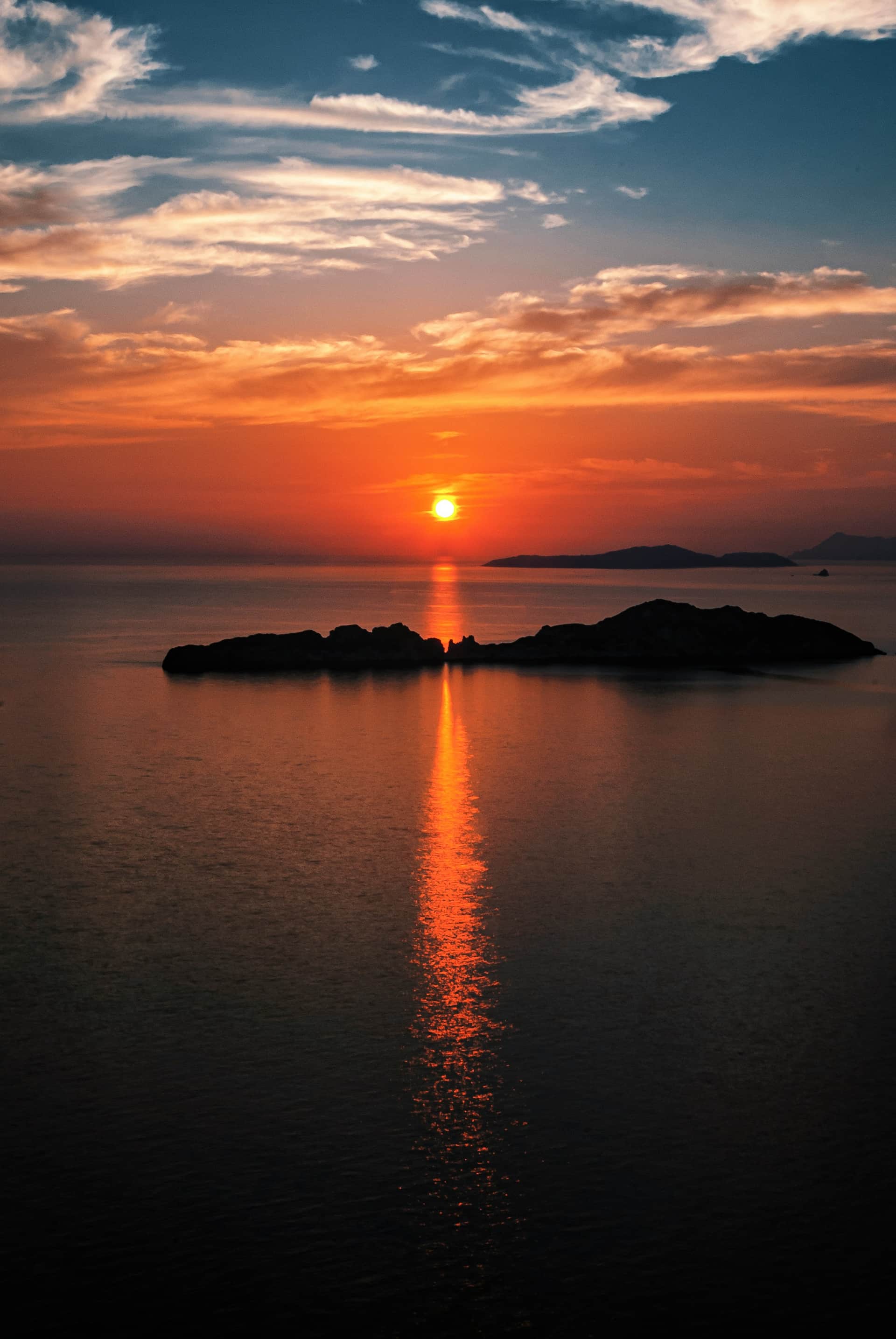
Monolithi is a large solitary rock rising from the sea off Paxos's west coast. There is no beach, no tourist infrastructure — but at sunset it turns a deep gold, and the view from a boat drifting nearby is one of the most striking in the Ionian Sea.
A shape on the horizon
Standing in Gaios in the late afternoon, looking west, you can see a dark silhouette standing alone in the sea — not close enough to make out details, but large enough to hold the eye. That's Monolithi: a single mass of limestone rising from the deep water off Paxos's west coast.
There is no road to it, no path, no beach landing. The only way to reach it is by boat. Which is exactly why almost no tourists ever see it up close.
The west coast approach
Leaving Gaios and heading south, the route to Monolithi takes you along the western cliffs — the dramatic face of Paxos that faces the open Adriatic. These are sheer walls, 50 to 150 metres high, broken by sea caves, natural arches, and small passages barely wide enough for a boat. There are no names on these features, no signs, no other vessels.
This coastal route, even without Monolithi as a destination, is one of the least-known and most rewarding experiences in the Ionian. Most visitors to Paxos never see this face of the island.
The rock itself
As you approach Monolithi, the scale registers. What looked like a moderate rock from Gaios turns out to be a substantial pillar — a wide, flat-topped limestone column that rises perhaps 20-25 metres from the surface. The water around it is deep and very dark: no shallow sandy bottom here, just the drop from open sea.
There is no landing possible. No ledge, no natural step, no place to tie a line comfortably. But you can anchor nearby, drift close, or let the boat rest in the lee while the current holds you gently off the rock face.
The sunset moment
The timing matters. Arrive at Monolithi between 18:00 and 19:30 (depending on season), and the low sun strikes the limestone directly. Cream-coloured rock catches late afternoon light in a way that makes it look lit from within — first pale gold, then deep amber, the colour changing as the sun descends.
The contrast with the surrounding sea is stark. The water stays dark; the rock goes orange. And there is no one else here. No other boats. No crowd jostling for position. Just your group, the rock, and the light working its way across the stone.
Compared with famous Greek sunsets
The famous Greek sunset — Oia in Santorini — is a performance with an audience of hundreds. People arrive hours early to secure viewing position. It's impressive, but it's also a managed experience with a queue.
Monolithi at sunset has no audience. The rock doesn't know you're there; the light does what it does regardless. You're not watching a spectacle — you're in a quiet piece of the Ionian that hasn't been turned into a tourist attraction because no one can easily get to it.
Combining with the sea caves
Monolithi and the Paxos sea caves (Ipapanti, Kastanida) are on the same route — both on the west coast, reachable in a single pass along the cliffs. A boat that leaves Gaios in the morning can cover the caves in the morning light (best for the colour inside Ipapanti), visit Antipaxos for swimming, and catch Monolithi on the return as the sun drops.
To see Monolithi at the right hour, book the AURA Paxos Cruise — full-day private charter covering the complete west coast, caves, and the Antipaxos beaches.
See all details of our private boat tour in Paxos.
Related Pages